DIY repair: compare the costs first
A broken household item creates a practical question: repair it, request a quote, or replace it? Start with the fault and the complete cost. A cheap part does not tell you the price of the whole job.
Use this planner for a repair you already understand. It helps you organize costs for small appliances, household electronics, and other repairable items. It does not diagnose faults or provide instructions for opening a device.
Repair cost calculator
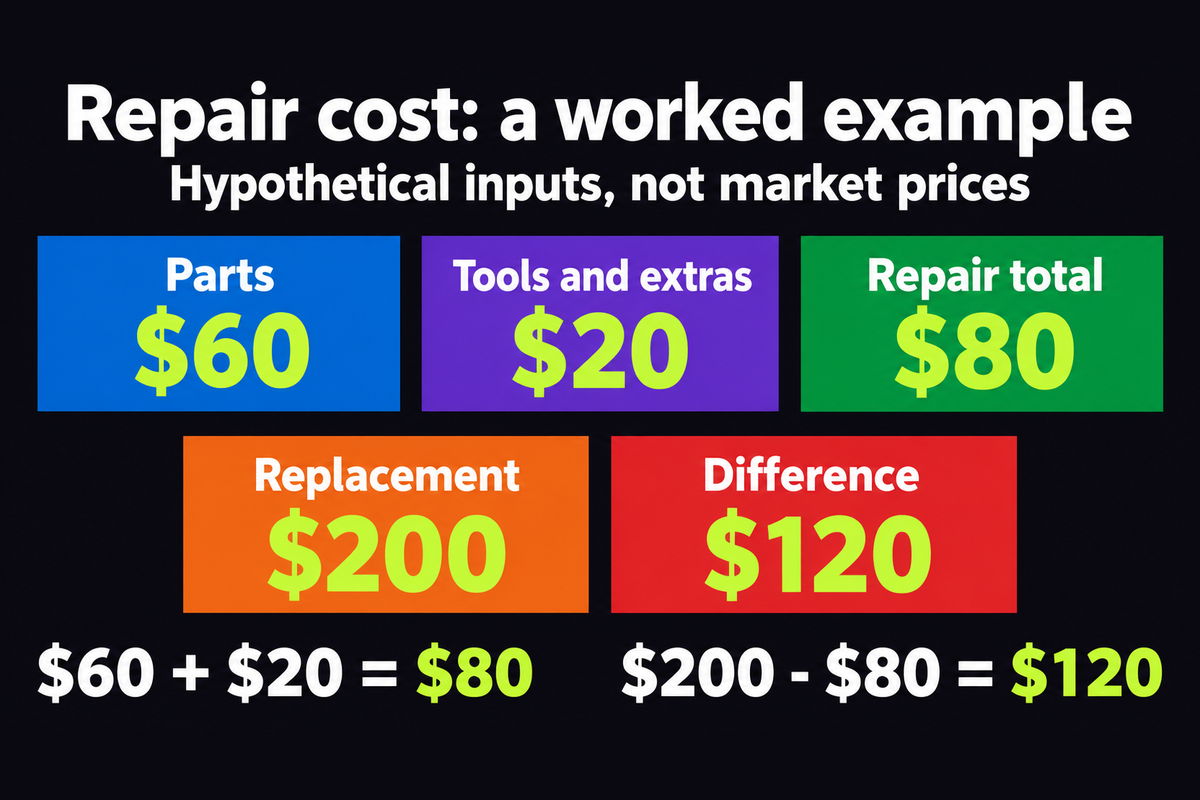
Enter all amounts in the same currency. Include tax and delivery in the appropriate field. Use an all-inclusive replacement price for a comparable item. The starting values are a hypothetical example, not quotes or typical prices.
Method: repair total = parts + tools and other costs + paid labor. Difference = replacement cost − repair total. Repair share = repair total ÷ replacement cost × 100. Results use your inputs and round to two decimal places. The tool runs locally without sending inputs.
Use zero for paid labor when you do the work yourself. Your time still matters, but this calculator does not assign it a price. It also excludes future faults, running costs, resale value, and differences in service life. A lower total does not establish that a repair is safe or worthwhile.
Identify the item before buying parts
Write down the brand, exact model, and serial number from the item label. Describe what happens in ordinary language: a loose handle, an error message, or an intermittent failure. Record when the problem started and any change that came before it. Keep the purchase receipt and the manufacturer's instructions together.
Use that information when you contact the manufacturer or a repair service. Ask for the exact part number and the procedure that applies to your model. Do not order a part only because its photograph looks similar. Ask whether the quoted part includes the fittings or seals that the procedure requires.
Check recalls first
The U.S. Consumer Product Safety Commission (CPSC) says recall remedies vary by product. Its About Us FAQ, checked in 2026, directs owners to the specific recall announcement for repair, replacement, or refund instructions.
Match the model and identifying details before you choose a repair route. Follow the notice's instructions about use of the item. Do not treat the calculator result as permission to continue using a recalled product.
Build a complete quote
Ask a repair service to separate diagnosis, parts, labor, transport, and taxes. Check whether the diagnostic fee counts toward the repair. Ask what happens if the technician finds another fault. Confirm which work the quote includes before you compare it with replacement.
For your own repair, list every tool and consumable you must obtain. Include return shipping where it applies. Check existing warranty or service coverage before paying for a separate repair.
Use the result as a planning aid
A positive difference means the entered repair total is lower than the entered replacement cost. A negative difference means the repair total is higher. Equal totals leave no immediate price advantage. None of these outcomes measures repair quality or predicts how long the item will last.
Repeat the calculation with a complete professional quote if you need another comparison. Put its parts and labor in separate fields only when the quote separates them. Otherwise, enter the complete quote in paid labor and leave the other repair fields at zero. This avoids counting the same charge twice.
The U.S. Environmental Protection Agency (EPA), in its 2021 archive of Reducing and Reusing Basics, recommends maintaining and repairing products to reduce replacement and disposal. That is a reason to consider repair, not a guarantee for every item. Keep the item-specific safety instructions and your own costs central to the decision.
Sources: CPSC, About Us FAQ (checked 2026); EPA, Reducing and Reusing Basics (2021 archive). This page provides a planning checklist and an arithmetic tool. For repair procedures, use the manufacturer's instructions or a qualified repair service.